Flow Sensor Types

- There are numerous flow sensor types on the market and it can be challenging to select the best option for an application.
- Operators should consider accuracy requirements, measured media type, conductivity, flow rates / flow range, and other factors when choosing the best flow meter for their application.
- When in doubt, it’s best for an operator to consult an engineering firm for design advice and assistance in choosing the best performance and best value flow meter.
There are numerous flow sensor types available today. The choice of which sensor type is best for an application largely depends on balancing price point with accuracy requirements and media type. For example, some sensor types are substantially more expensive than more basic sensor technologies and not all applications require such accuracy. In other situations, highly accurate flow meter requirements necessitate the use of highly sophisticated flow sensor technologies. While in other circumstances, the media type, whether viscous, corrosive, conductive, or otherwise hard to handle, will likely affect which flow sensor option is the best choice.
Mass Flow vs. Volumetric Flow
Let’s start by discussing the two major ways that flow can be measured – mass flow vs. volumetric flow. To avoid confusion when discussing flow, or flow rate, it is important to use the correct terms. Furthermore, the concepts of flow rate, whether volume flow rate or mass flow rate, are clear. Generally, flow rate can be understood as the actual velocity (V) of the moving fluid. Volumetric Flow Rate (Q) is a unit such as cubic feet, cubic meters, liters, etc. that flows through a cross sectional area (A) such as a pipe or duct. The formula Q = V x A represents Volumetric Flow Rate.
Conversely Mass Flow Rate (M) is the quantity of fluid that flows in terms of pounds, grams, tons, etc. per unit time. The formula M = ρ x A x V represents Mass Flow Rate. Density (ρ) has a great effect on compressible fluids such as gasses, whereas it has a minor effect on liquids. Unlike volumetric flow rate, direct measurement of a mass flow rate is not dependent on environmental factors such as pressure and temperature.
Most flow meters are volumetric but can infer mass flow through calculations that consider other physical process measurements. for example, absolute pressure, differential pressure, temperature, and viscosity readings all affect mass flow as a derivative of volumetric flow. This method of obtaining a mass flow output is known as inferential mass flow, which is different than direct mass flow measurement.


Standard Flow vs Ultra Low Flow
For most applications, operators are going to use standard rate flow meters. These flow meters often operate in ranges of gallons per minute, liters per minute, etc. This is the range the applies to many industrial applications such as oil and gas processing, municipal water treatment, and others. However, there is a flow range sometimes referred to as (ultra) low flow. This term typically applies to applications like laboratory research and education, pharmaceutical production, gas analysis, liquid dosing, and other flows relatively in the grams per hour range.
Constant Temperature Thermal Mass Flow Meters
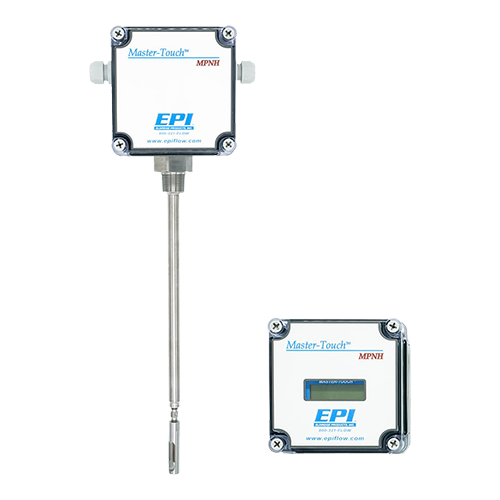
Constant temperature thermal mass flow meters, such as those from Eldridge Products Inc. (EPI), are thermal mass flow meters that rely on heat loss to determine flow rate. For rugged thermal sensors, Kayden Instruments is an excellent option. For ultra low flow rates, Bronkhorst is a great solution. Constant temperature thermal mass flow meters require two active sensors, typically platinum RTDs. These RTDs operate in a continuous state of balancing. The first RTD acts as the active heat sensor. Meanwhile, the second RTD acts as a temperature sensor reference. Heat loss from the flowing fluid tends to unbalance the active heat flow sensor. Thus, the flow meter’s electronics must force the RTD and back into balance.
With this method of operating constant temperature flow sensor types, the fluid flow heat loss only affects the skin temperature. This allows maintenance of the sensor core temperature. Furthermore, it produces a very fast response to fluid velocity and temperature changes. Additionally, because power applies only as necessary, the system has a wide operating range of flow and temperature. The active heat sensor maintains an index of overheat above the environmental temperature from the reference RTD. This virtually eliminates the effects of variations in density by molecular heat transfer and sensor temperature corrections. These meters typically have an effective turndown ratio of 100:1 when they are the proper size.

Constant Power Thermal Mass Flow Sensor Types
Constant power thermal mass flow meters are thermal (heat loss) mass flow meters, also produced by EPI, and require two active elements. A constant current heat element acts a heat loss flow sensor. Meanwhile, a second RTD operates as an environmental temperature sensor. When the fluid is at rest, the heat loss is at a minimum. Heat loss increases with increasing fluid velocity. In this method of operation, the mass of the sensor must change its temperature, making it slow to respond to fluid velocity changes.
In addition, this method has a limit in useful temperature range due to the application of constant current. The dynamic temperature range may increase by applying more power (current) to the heater. But this can result in excessive heat application to the heater when the fluid is at rest. Molecular heat transfer and sensor temperature corrections virtually eliminate the effects of variations in density. These flow sensor types typically have a turndown ratio of 100:1.
Calorimetric or Energy Balance Thermal Mass Flow Sensor Types
Calorimetric, or energy balance, thermal mass flow meters require one heating element and two temperature sensors. Although many design variations exist, they all have a similar operating method. Typically, the heater attaches to the middle of a flow tube with a constant heat input. Two matching RTDs, or thermocouples, then attach equidistant upstream and downstream of the heater. The flow meter produces an output signal by sensing the temperature differential at flowing conditions.
Because both temperature sensors see the same temperature and pressure effects, density changes inherently do not affect the design. As a result, these flow meters produce a true mass flow output. Limitations of this flow meter design include a maximum flow rate of 200 liters per minute, nonindustrial packaging, and a tendency to clog in dirty fluids. These flow sensor types typically have a turndown ratio of 10:1.
Coriolis Mass Flow Meters
Coriolis mass flow meters provide a direct mass flow measurement and are easy to size for process requirements. For ultra low flow rates, we recommend Bronkhorst. Or for high Coriolis flows, KROHNE is a great option. The principle of operation for these flow sensor types is the Coriolis effect. More specifically, these flow meters rely on the conservation of angular momentum due to the Coriolis acceleration of a fluid stream. Basically, when an excitation force applies to a tube, it begins to vibrate. And this vibration causes the fluid flowing through the tube to rotate or twist within the tube. This phenomena is due to the Coriolis acceleration acting in opposite directions on either side of the force.
Various tube designs, excitation sources, and sensors may be of use in Coriolis mass flow sensor types. Coriolis mass flow meters are often much larger in size in comparison to other types of flow meters. While Coriolis flow meters are extremely accurate, when purchase price is of concern, Coriolis mass flow meters may not be an option due to their high price. These flow sensors types typically have a turndown ratio of 10:1.


Differential Pressure Flow Sensor Types
Differential pressure flow meters, or DP flow meters, provide a volumetric flow rate output. These flow meters, such as those from KROHNE or Core Sensors, require a pressure gage or sensor. Then, this pressure sensor connects across their pressure ports for flow sensing. If mass flow rate outputs are necessary, differential pressure flow meters require additional readings to infer mass flow. Manual or computer calculations incorporating physical process measurements such as absolute pressure, differential pressure, temperature and viscosity readings must apply to the output signal to obtain the actual flow rate.
Orifice or orifice plate, nozzle or flow nozzle, flow venturi or venturi tube, pitot tube or pitot static tube, elbow or flow elbow, loop or flow loop flow meters are all differential pressure flow meters. Variations on these are the sonic nozzle and the sonic venturi. Differential pressure flow sensor types typically have a turndown ratio of 10:1.
Magnetic Flow Meters, or Magmeters
Magnetic flow meters, or magmeters, follow Faraday’s law of Electromagnetic induction and only work on conductive fluids. For most flow rates, KROHNE is a great option, but for ultra low flows, Bronkhorst offers a solution. In a magnetic flow meter, an electromotive force (flux) generates perpendicular to the conductive fluid as it passes through a magnetic field in a nonmagnetic conduit. Then, either a pulsed DC current or sinusoidal AC current excites an electromagnet. Through ion exchange, an electromotive force (emf) produces across an electrode pair. Thereby, it provides the magnetic flow meter with an emf output signal proportional to the fluid velocity.
Magnetic flow meters are useful in conductive liquid flow applications exclusively. Normally, when installed they provide an unobstructed flow. Typically, the minimum conductivity of the fluid is in the order of 0.1 microseisms/cm. So, magnetic flow meters won’t work for most gases and petroleum products. These flow sensor types typically have a turndown ratio of 10:1.

Positive Displacement Flow Meter
Positive displacement flow meters may incorporate oval or helical gears, pistons, lobed impellers, sliding vanes, or nutating disks. These flow meter sensor types entrap a known quantity of fluid per pulse. Then, by totaling up the pulses over time, the fluid flow rate is known. If mass flow rate outputs are necessary, then the positive displacement flow meter requires other readings to infer mass flow. To obtain the actual flow rate using the output signal, manual or computer calculations must incorporate physical process measurements such as absolute pressure, differential pressure, temperature and viscosity readings.
Target Flow Meters
Target flow meters may be of use where rough accuracy is necessary or where the fluid is extremely dirty. A disk or body immerses into the fluid stream perpendicular to the flow. A strain gage or force balance sensor then measures the differential pressure forces acting on the target. The magnitude of the strain gage signal or energy necessary to maintain balance is proportional to the fluid flow. Target flow meters may be useful in applications where the flowing fluid has sufficient momentum to satisfy the pressure differential requirement.
The target flow meter positions where turbulence, pulsation, or vibrations are minimal. If mass flow rate outputs are necessary, then the target flow meter requires other readings to infer mass flow. To obtain the actual flow rate from the output signal, manual or computer calculations must incorporate physical process measurements such as absolute pressure, differential pressure, temperature and viscosity readings. These flow sensors typically have a turndown ratio of 10:1.
Turbine Flow Sensor Types
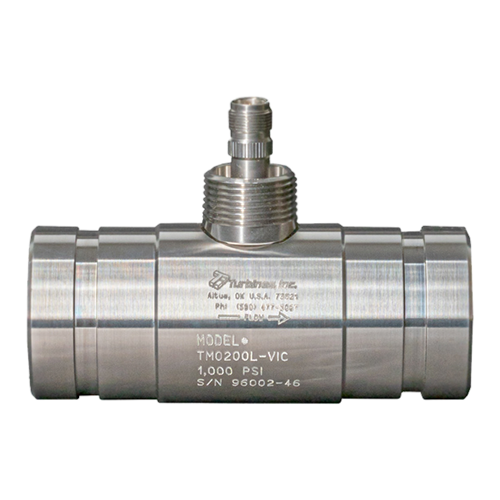
Turbine flow meters consist of inlet flow conditioners, rotors, rotor supports, rotor bearings, housing, and signal pickoff coil. A turbine rotor has multiple blades. The pickoff coil senses the velocity of rotation, which is proportional to flow. However, turbine flow meters are sensitive to density and viscosity fluctuations. If mass flow rate outputs are necessary, then turbine flow meters require other readings to infer mass flow.
To obtain the actual flow rate from the output signal, manual or computer calculations must incorporate physical process measurements such as absolute pressure, differential pressure, temperature and viscosity readings. Clean fluids are necessary to prevent contamination of the bearings unless sealed bearings are in use. Turbine flow sensor types typically have a turndown ratio of 10:1, but with special care, it is possible to achieve 20:1. Other rotational meters are the propeller, paddle wheel, impeller, rotor, and rotating cup flow meters.
Ultrasonic Flow Meter
Ultrasonic flow meters may have sensing elements clamped external to the pipe or immersed in the fluid. For most flow rates, KROHNE is a great option, but for ultra low flows, Bronkhorst offers a great solution. Two basic sensing methods are generally useful for air flow measurement: the time of flight (transit time) or Doppler method. Time of flight ultrasonic flow meters measure the difference in time travel between pulses sent with and against the fluid flow. Two sensors are necessary, one upstream and the other downstream. The signal transmits in both directions to get the time differential.
Doppler ultrasonic flow meters apply the Doppler effect to measure flow rate. This method requires particles or bubbles in the fluid stream. If the signal output is equal to the signal input, then the fluid is not flowing. A frequency shift will occur with flowing fluid, and the shift will get proportionately greater with increasing fluid velocity.


Variable Area Flow Sensor Types, or Rotameters
Variable area flow meter (VA meters), or rotameters, such as those from KROHNE, have a tapered bore and float. Floats may have a number of design variations from a simple ball to complex designs. The tube bore designs may also vary. The operating principle is a dynamic balance condition. When the upward forces of the flowing fluids equal the weight of the float, the float will be buoyant at a level within the tapered bore. The annular area around the float increases with increasing fluid flow. These meters typically have a turndown ratio of 10:1.
Vortex Shedder Flow Meters
Vortex shedder flow meters, such as those from KROHNE, apply the von Kármán vortex shedding phenomenon. For ultra low flow rates, check out our solutions from Bronkhorst. As the fluid flows over a bluff body, vortices alternately form downstream on either side of the bluff body. The frequency of the vortices are proportional to the fluid velocity.
Various sensing methods for airflow measurement can apply to measure the frequency of the vortices. If mass flow rate outputs are necessary, then the vortex shedder flow meter requires other readings to infer mass flow. To obtain the actual flow rate from the output signal, manual or computer calculations must incorporate physical process measurements such as absolute pressure, differential pressure, temperature and viscosity readings.
