Thermal Mass Flow Meters vs Orifice Plates
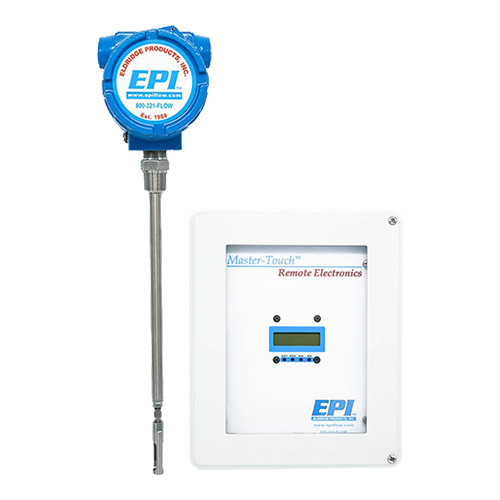
- Thermal Mass Flow Meters offer a lower installation cost with simple insertion probe and minimal piping modifications compared to orifice plates.
- EPI’s Flow Meters for gases provide easy field validation using EPIVAL — only recalibrate when needed.
- Thermal Flow Meters offer direct mass flow measurement with no need for separate temperature or pressure compensation.
When it comes to selecting a flow measurement technology, many operators default to traditional options like orifice plates. They’re familiar, low-cost, and widely used. However, for those who look beyond the upfront price tag and consider long-term performance, accuracy, and total cost of ownership, Eldridge Products’ thermal mass flow meters offer a compelling alternative.
Total Cost of Ownership Matters
When choosing the best flow technology for your operation, cost inevitably becomes a key consideration. While we prefer to focus on value—how a solution solves real-world challenges—price does play a role. That’s why it’s important to go beyond just the cost of the instrument and consider the total cost of ownership, including installation, maintenance, calibration, and supporting infrastructure.
One of the biggest advantages of Eldridge thermal mass flow meters is their low installation cost. This is especially true for simple insertion-style probes, requiring only a basic weld-o-let fitting—typically 1/2″, 3/4″, or 1″. This makes for an easy, non-intrusive installation that can often be done without shutting down the process. In contrast, orifice plates demand significantly more piping modifications. You’ll need to cut into the line, weld on flanges, and maintain a precise fit. Add to that the need for differential pressure transmitters and additional temperature and pressure sensors if you want to calculate mass flow—and the “low-cost” orifice plate starts to look more expensive.
Ease of Use and Maintenance in Thermal Mass Flow Meters vs Orifice Plates
Another key consideration is ease of maintenance. One of the biggest pain points for any flow measurement technology is calibration. While all thermal mass flow meters eventually need recalibration, Eldridge’s EPIVAL calibration validation feature simplifies this process dramatically. Instead of pulling all your meters for factory calibration on a fixed schedule, EPIVAL lets you verify calibration performance in the field in five minutes or less. Only meters that show drift need to be sent in, thus saving time, labor, and unnecessary downtime.
Compare this to orifice plates and differential pressure systems, which often require field provers or multiple instruments working in concert, not to mention more man-hours to validate accuracy.
Direct Mass Flow Measurement via Thermal Mass Flow Meters vs Orifice Plates which Require Compensation

If you’re measuring mass flow—and most industrial users are—thermal mass flow meters have another major edge. Unlike orifice plates, which measure volumetric flow and must be corrected for temperature and pressure, thermal mass flow meters inherently measure true mass flow. EPI’s flow meters integrate temperature sensing and flow measurement into a single device, with no need for external compensation sensors or transmitters. That’s fewer components, fewer failure points, and a simpler, more reliable system.
Final Thoughts
Choosing the right flow meter isn’t just about the purchase price—it’s about long-term value. Eldridge Products’ thermal mass flow meters offer easier installation, lower maintenance, direct mass flow measurement, and quick calibration checks, thus making them a smarter investment for most applications. Whether you’re working in aeration, combustion, or submetering, our meters are designed to simplify your process, reduce costs, as well as improve performance over time.